https://arxiv.org/abs/2306.11695
A Simple and Effective Pruning Approach for Large Language Models
As their size increases, Large Languages Models (LLMs) are natural candidates for network pruning methods: approaches that drop a subset of network weights while striving to preserve performance. Existing methods, however, require either retraining, which
arxiv.org
본 Paper Review에 앞서, 이 Paper를 선택한 이유
- 현재 pruning 관련 연구를 진행 중이며, LLM(대형 언어 모델) 대상의 post-training pruning(사후 프루닝) 기법에 대한 실용적·간단한 베이스라인이 필요
- Wanda는 계산 비용이 낮고 retraining 없이(혹은 최소의 데이터만으로) 적용 가능한 방법이라서 baseline/비교군으로 적절하다고 판단
0. Abstract
- network weight의 subset을 drop하는기존 method에는 두가지 문제점이 존재
- 감당할 수 없는 retraining이 필요
- second-order information에 의존하는 reconstruction problem 발생
⇒ Pruning by Weighs and activations (Wanda) 기법 제시- output 별로 input activation과 곱해진 가중치 크기가 가장 작은 것들을 pruning
- retraining이나 weight를 update하지 않고, 직관적인 방법
Second Order Information
머신러닝에서 더 빨리 수렴하기 위해 gradient와 곡률(curvature) 정보를 활용하는 최적화 방법
1. Introduction
- 대부분의 LLM은 상당한 많은 양의 parameter로 computational resource가 많이 필요
→ 양자화 방법(parameter를 저비트 수준의 representation으로 변환)
→ Network pruning 방법(weight를 0으로 설정하여 제거) - 기존 pruning method의 문제점
- retraining (Liu et al., 2019; Blalock et al., 2020)
- random initialization (Zhu & Gupta, 2017; Louizos et al., 2018; Gale et al., 2019)
- extensive 반복 과정 (Frankle & Michael, 2019; Renda et al., 2020)
- Wanda 기법 💡
- weight를 수정하지 않고 높은 sparsity의 pruning (= 많이 pruning이 가능해짐)
- hidden state feature의 일부가 큰 값을 가진다는 것에서 착안
- weight magnitude pruning metric + input activation의 norm 곱이 weight importance를 평가하는 데에 효과적
- 따라서, linear layer의 각 output 안에서의 weight끼리 비교하여 우선순위가 작은 weight를 제거하는 method
- weight를 수정하지 않고 높은 sparsity의 pruning (= 많이 pruning이 가능해짐)
2. Preliminaries
- Magnitude Pruning
- 각 laher 안에서 weight를 locally하게 비교해서 threshold를 정함
or - 전체 network에서 globally하게 정함
- 각 laher 안에서 weight를 locally하게 비교해서 threshold를 정함
- Emergenet Large Magnitude Features
- hidden state feature의 일부가 다른 것들에 비해 큰 수치를 가지고 있음 = outlier features
- 매우 큰 수치이며 (전형적인 hidden state value에 비해 100배 이상 차이 발생),
- 특정 feature 차원에서만 나타나고
- LLM의 predictive한 능력을 보기에 필수이기에 중요
- hidden state feature의 일부가 다른 것들에 비해 큰 수치를 가지고 있음 = outlier features
- Calibration dataset
- 목적: pruning 과정에서 모델의 input acviation의 특성을 추정하기 위해 사용하는 소규모 데이터 샘플 모음, 각 입력 채널 h 의 활성화 통계를 추정()
- 논문 권장값: C4에서 128 sequences를 사용(실험적으로 128이면 안정적이며 더 늘리면 완만 개선)

3. Wanda: Pruning by Weights and Activations
- Pruning Metric
채널 노름: n_j := ||X_j||2
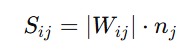
- input channel의 weight가 magnitude(절댓값) feature가 클 경우, weight의 magnitude가 작아도 imporatnce score가 커짐으로써 large magnitude feature가 Wanda에서는 유지됨을 알 수 있음
- 프루닝 규칙: 각 output row 에 대해 S_i 를 정렬하고 하위 에 해당되는 weight를 0으로 만듦 (row-wise unstructured pruning)
⇒ SparseGPT(및 OBD/OBS) 관점에서의 local reconstruction objective를 단순화하면 Hessian의 대각 성분들이 분모에 나타난다. 대각 근사(=비상관 가정)과 damping λ→0 를 적용하면 중요도는 대략 위 식으로 유도 가능하다.
Wanda는 SparseGPT의 복잡한 2차 정보 지표를 효율적으로 근사하는 직관적 지표

헤시안 행렬
함수의 curvature(곡률)을 분석하기 위한 2차 미분 행렬
딥러닝에서는 loss function이나 레이어의 출력에 대해 미분을 여러 번 해서 얻는 행렬로, 각 파라미터 쌍의 곡률 정보를 담고 있음
Damping (댐핑)
헤시안 행렬을 역행렬로 계산하려면 불안정할 수 있으므로, 헤시안이 거의 0에 가까운 값이 생기면 역행렬 계산이 되지 않아 결과가 왜곡될 수 있으므로 이런 현상을 막기 위해 H에 작은 수 람다를 더해서 안정화시키는 방법
Pseudo Code
# W: (C_out, C_in), sum_sq: (C_in,) accumulated across calibration tokens n = torch.sqrt(sum_sq) # (C_in,) metric = W.abs() * n.unsqueeze(0) # broadcast -> (C_out, C_in) k = int(C_in * sparsity) # number to prune per row # get indices of smallest k elements per row vals, idx = torch.topk(metric, k, dim=1, largest=False) W_pruned = W.clone() W_pruned.scatter_(1, idx, 0.0)
4. Experiments
Models & Baselines
- 모델들: LLaMA 계열(7B, 13B, 30B, 65B) 및 LLaMA-2(7B, 13B, 70B)
- Calibration data: C4에서 128 sequences (기본). 일부 실험은 1, 8, 128, 1024 등 다양한 샘플 수로 민감도 실험
- 평가:
- Zero-shot accuracy: 논문에서 7개 태스크 평균(예: PIQA, WinoGrande, ARC, HellaSwag)
- Perplexity: WikiText(또는 텍스트 데이터 셋) 검증 셋에 대한 perplexity 측정
- 속도: metric 계산 시간, 전체 프루닝 처리 시간, 그리고 구조화(2:4) 적용 시 matmul inference throughput 측정
4.1 Zero-Shot Tasks
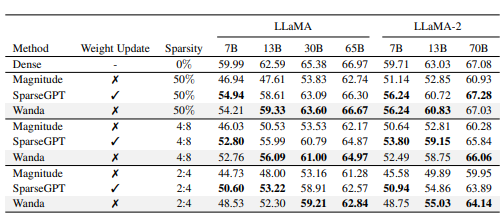
- Magnitude pruning → 성능 급락, 예: LLaMA-7B, 50% sparse에서 55% 수준
- Wanda pruning → 50% sparse에서도 Dense 성능과 거의 유사, SparseGPT와 근접
- SparseGPT → 여전히 가장 높은 성능이지만 Wanda와 차이가 작음
- LLaMA-65B (50% sparse) 에서는 Wanda가 Dense와 거의 동일한 평균 zero-shot 정확도 달성 → Large Sparse 모델이 Small Dense 모델보다 나음
4.2 Language Modeling
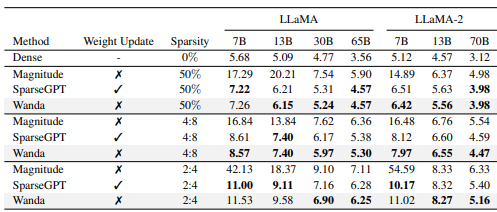
- 주요 결과 (LLaMA-7B, 50% unstructured sparsity):
- Dense: (기본 perplexity 수치)
- Magnitude: 17.29
- Wanda: 7.26
- SparseGPT: 7.22
- magnitude 대비 압도적 개선, SparseGPT와 사실상 동일 성능
- 다른 모델 크기(LLaMA-13B, 30B, 65B / LLaMA-2 7B, 13B, 70B)에서도 동일 경향
4.3 Speed up
- Wanda는 한 레이어의 metric 계산 시간이 SparseGPT 대비 수십 배 빠름.
- 전체 모델 pruning도 훨씬 빠르게 끝남 → 대규모 LLM baseline 실험에 적합

5. Analysis
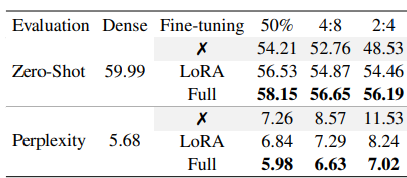
- Fine-tuning 효과
- Wanda로 pruning한 LLaMA-7B 모델에서 성능 하락 발생함
- LoRA나 full parameter fine-tuning 적용하면 성능 복구 가능
- LoRA는 적은 자원으로도 일정 수준 회복 가능
- full fine-tuning은 dense 모델 성능에 근접하게 끌어올림
- Pruning configuration
- Wanda는 weight importance metric과 comparison group 모두 기존 방법과 다름
- Ablation 실험 결과, per-output 기준의 grouping이 가장 효과적
- magnitude pruning도 grouping 방식에 따라 성능 차이가 큼

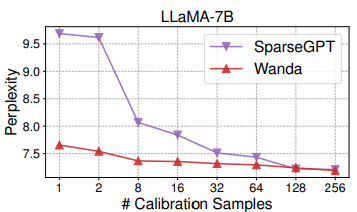
- Calibration data 개수 영향
- Wanda는 calibration sample 수가 적어도 안정적
- SparseGPT는 샘플 수 적으면 성능 불안정하지만, Wanda는 단 1개 샘플로도 성능 유지
- Weight update 효과
- SparseGPT는 weight update 필요하지만 Wanda는 거의 개선 X
- unstructured 50%와 4:8 sparsity에서 update 불필요, 2:4 sparsity에서만 아주 미미한 개선 있음

6. Conclusion
- Wanda는 LLM을 위해 단순하면서도 효과적인 pruning 방법 제시
- 핵심은 weight 크기 × input activation norm 기반 pruning metric + per-output basis 비교
- retraining이나 weight update 필요 없이 pretrained LLM에서 바로 sparsity 유도 가능
- 실험 결과, magnitude pruning보다 훨씬 우수하고 SparseGPT에 준하는 성능 보임
- Wanda는 빠른 속도와 간단한 구조 덕분에 sparse training 환경에도 유용할 가능성 있음